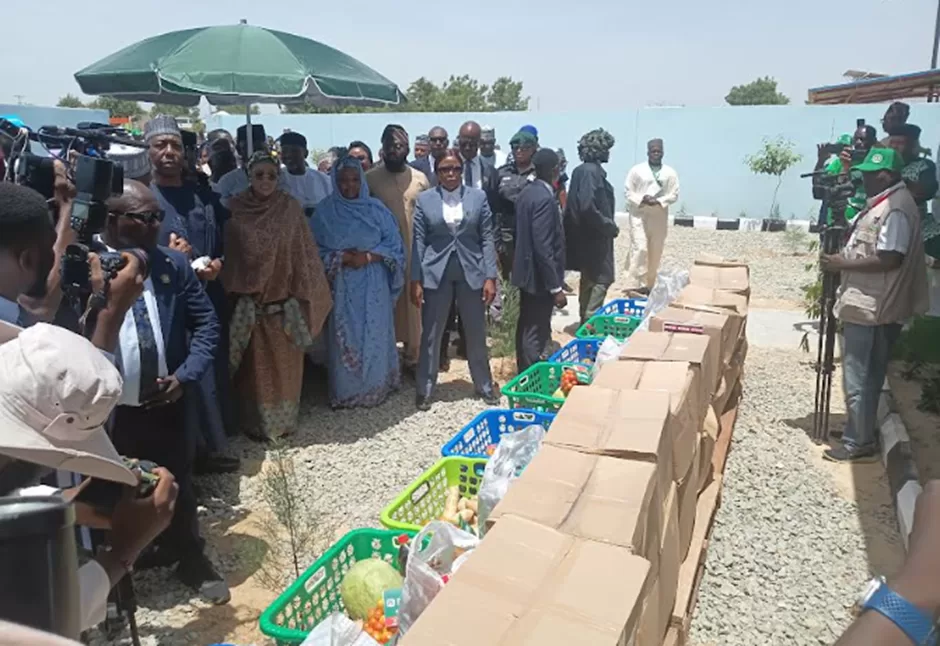
Nigeria’s First Lady, Oluremi Tinubu, on Monday unveiled the National Community Food Bank Programme in the North-East, marking a significant step in efforts to combat hunger and malnutrition in one of the country’s most vulnerable regions.
The launch took place in Maiduguri, during her official visit to Borno State, where she described the initiative as a priority intervention for women and children.
Addressing dignitaries at the event, the First Lady said the programme reflects a commitment to improving nutrition outcomes across Nigeria, particularly among at-risk populations.
“It is a great honour and privilege to be here. This will be the first assignment while we are here in Borno State for our children and mothers,” she said.
“I have the honour to commission the National Community Food Bank Programme in the North-East to the glory of God.”
A coordinated response to food insecurity
The National Community Food Bank Programme is designed to establish food banks across all 774 local government areas in Nigeria. These centres will be linked to primary healthcare facilities supported by the Basic Health Care Provision Fund, in partnership with the Bank of Agriculture.
Under the scheme, nutritious and locally sourced food will be distributed through a voucher system targeting malnourished children under six, pregnant and nursing mothers, orphans, and other vulnerable households.
The initiative is part of broader efforts by the administration of Bola Tinubu to address rising food insecurity and nutrition challenges, particularly in regions affected by conflict and economic hardship.
Billions pledged at national launch
The unveiling in the North-East follows a major funding drive earlier in April at the State House Conference Centre in Abuja, where over ₦66 billion in pledges were secured from public and private sector stakeholders.
Speaking at that event, the Coordinating Minister of Health and Social Welfare, Ali Pate, disclosed that the programme had attracted strong backing from leading organisations.
The Aliko Dangote Foundation led contributions with a ₦20 billion in-kind commitment spread over five years, while the Nigerian National Petroleum Company Limited pledged ₦10 billion within the same period.
Additional support came from the Emeka Offor Foundation, which donated ₦500 million upfront, alongside $500,000 (approximately ₦750 million) from anonymous donors.
Furthermore, President Tinubu approved a special ₦17 billion intervention fund through the Social Action Fund to support the rollout of the programme nationwide.
Tackling a Pressing National Challenge
The North-East has long faced acute humanitarian challenges driven by insurgency, displacement, and limited access to basic services. Experts say targeted nutrition interventions such as community food banks could play a critical role in reducing child mortality and improving public health outcomes.
With its focus on local sourcing and community-level distribution, the programme is expected to not only address immediate hunger but also stimulate local agricultural value chains.
As implementation begins in the North-East, attention will turn to how quickly the initiative can be scaled nationwide—and whether it can deliver sustained relief to millions of Nigerians facing food insecurity.